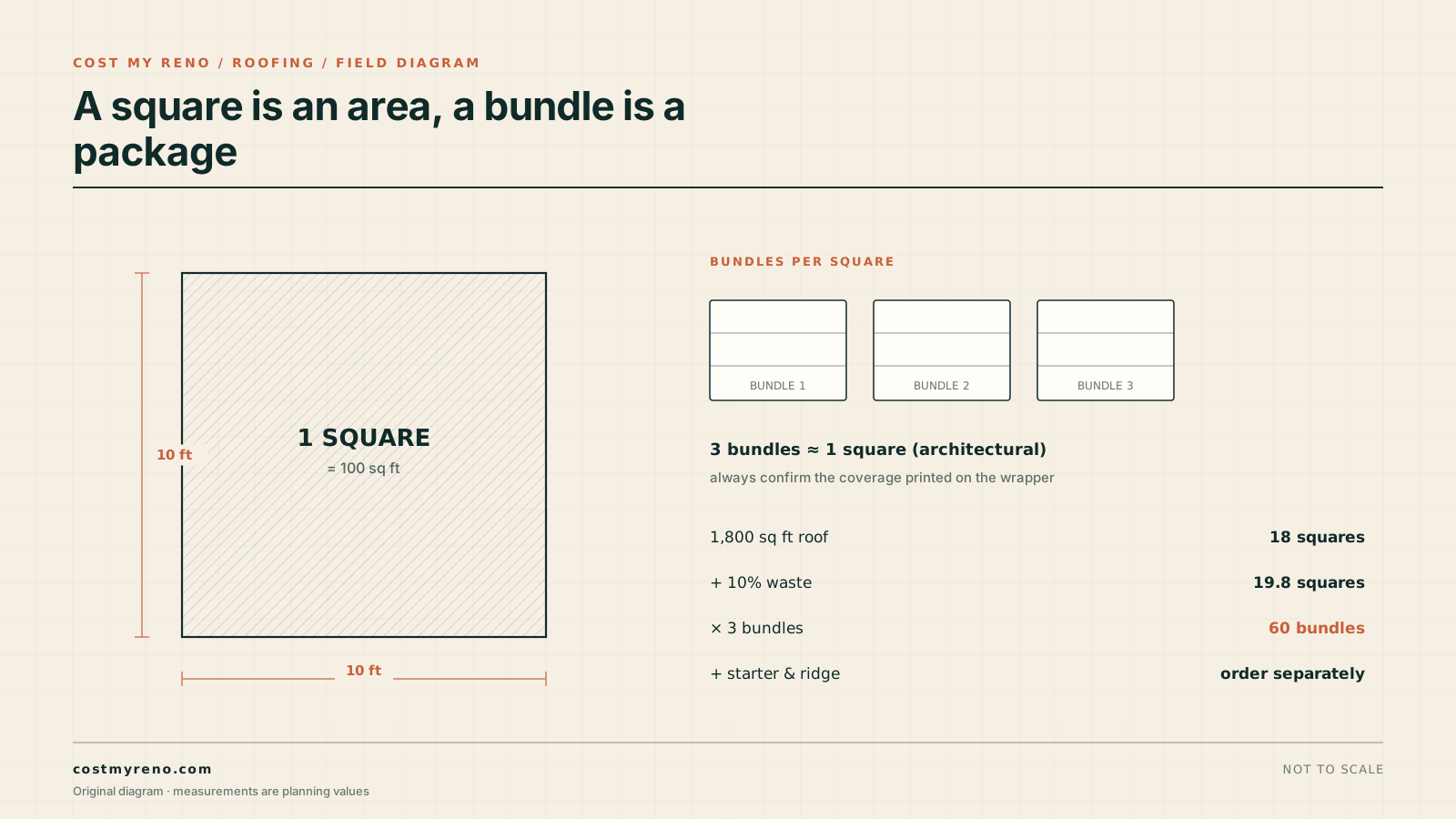
A square is 100 sq ft of roof surface, never 100 sq ft of footprint. Correct the plan area for pitch and overhangs first, then read bundles per square off the product wrapper, where it is usually three and sometimes four or five.
Numbers to plan with
Plan area is the starting number, never the final one
A 40 by 28 ft ranch footprint measures 1,120 sq ft. At a 6:12 slope the finished roof surface is 1,120 times a factor of 1.12, or about 1,254 sq ft. That is 134 sq ft more than the footprint and 1.34 squares that never appear on a footprint-only takeoff. Every quantity downstream, from underlayment rolls to tear-off labor to the dumpster, is priced off the larger number, which is why a roofer asks for pitch before asking for a price.
Overhangs belong in the plan area. A 12 in eave and an 18 in rake widen that same building to roughly 43 by 30 ft once both sides are counted: 1,290 sq ft of horizontal plan, 1,445 sq ft of surface at 6:12. Measure to the roof edge or the fascia line, not the foundation. On the gable ends, the 18 in rake also lengthens the rakes that have to be trimmed and capped, so it shows up twice in the order.
Sketch each plane instead of forcing the roof into one rectangle. A main gable, a porch at a shallower pitch, a garage tie-in, and a dormer are four separate multiplications with four separate factors. Two planes that meet at a valley share a line, not an area, so measure each one to the valley and stop there rather than overlapping the two.
- Plan area: length times width measured to the roof edge, including eave and rake overhang
- Surface area: plan area times the pitch factor for that specific plane
- Separate planes: main roof, porch, garage, dormers, and any addition with a different slope
- Report to one decimal place, then apply waste once at the end
Reading a pitch without standing on it
Rise over run is the one measurement that reliably tempts people onto the roof, and it is usually the least necessary one. A 12 in level held against the gable rake from a stepladder, an attic measurement taken along a rafter, or an aerial measurement report all answer the question without putting anyone on a slope. Hold the level horizontally at the eave, mark 12 in out, and measure vertically from that mark to the rake line. A 7 in rise is a 7:12 roof.
If the only way to confirm a dimension is to walk the roof, the estimate is not worth the measurement. Wet shingles, morning dew, moss, and loose granules make a 4:12 roof slippery before it looks steep, and a fall from eave height puts a person in a hospital for reasons that have nothing to do with roofing skill. OSHA's residential fall-protection requirements apply to anyone on that roof, including the homeowner holding the other end of the tape.
Attic access is the compromise most estimators use when the gable end is obstructed. Measure 12 in of horizontal run along the bottom edge of a rafter, then measure the rise to the rafter's top edge at that point. Insulation, ductwork, and low headroom make it a two-person job, and a half-inch error over 12 in changes the area by roughly 4%, so repeat the measurement on a second rafter before trusting it.
Squares turn surface area into something a crew can price
One roofing square is 100 sq ft of finished roof surface. The 1,445 sq ft example is 14.45 squares, and that is the number to carry through the estimate, not 14 and not 15. Labor, tear-off, underlayment, and disposal all use the same unit, so a fractional square is worth keeping until the last conversion.
Order matters when you apply waste. Rounding 14.45 down to 14 and then adding 10% yields 15.4 squares. Adding 10% first yields 15.9. On architectural shingles installed around $600 per square, that half square is roughly $300 of scope that disappears from the bid and reappears later as a change order or a thin final course at the ridge.
Squares also frame the warranty and inspection conversation. Manufacturers publish application limits, wind classifications, and ventilation requirements per product, and an inspector will compare the installed quantity with the approved scope. If a proposal lists 18 squares for a roof you measured at 22, ask which planes were left out before arguing about the price per square.
Bundles per square come off the wrapper, not out of habit
Three bundles per square is a convention for standard three-tab and architectural products, and nothing more than that. The wrapper states coverage. A bundle covering 33.3 sq ft is three bundles per square, 25 sq ft is four, and 20 sq ft is five. Some metric-labeled products print square meters instead, so convert before comparing two prices that look similar.
The same 15.9-square order therefore becomes 48 bundles at three per square, 64 at four per square, or 80 at five. That is a 33% to 67% swing in material cost and roughly 2,000 lb of additional load on the delivery, all driven by packaging choices made before anyone opens a ladder.
Buy in bundles and think in squares. A 48-bundle order is exactly 16.0 squares at three per square, which is why the crew will call it a 16-square roof even though the measured surface was 14.45. The difference is waste, not measurement error, and it should be visible on the delivery ticket rather than absorbed silently into the labor rate.
Planning figures by shingle class. Read the actual wrapper and the supplier's pallet configuration before ordering; these are conventions, not product specifications.
| Shingle class | Bundles per square | Sq ft per bundle | Typical pallet | Weight per square |
|---|---|---|---|---|
| Three-tab, 25 year | 3 | 33.3 | 48 to 60 bundles | 210 to 250 lb |
| Standard architectural | 3 | 33.3 | 42 to 48 bundles | 350 to 450 lb |
| Heavy laminated or luxury | 4 | 25.0 | 30 to 36 bundles | 450 to 550 lb |
| Designer high-exposure | 4 to 5 | 20 to 25 | 24 to 30 bundles | 500 to 600 lb |
| Synthetic slate or shake | 4 to 6 | 16.7 to 25 | 20 to 28 bundles | 450 to 650 lb |
Waste follows geometry and cut count, not the shingle price
A clean gable with two rectangular planes and no dormers wastes 8 to 10% in normal cutting. A hip roof wastes 10 to 12% because every hip produces a compound cut at both ends of the run. Valleys, dormers, multiple roof levels, and short runs push the allowance to 12 to 15%, and a cut-up roof with turrets, six or more planes, and runs under 8 ft can reach 15 to 18%.
Run the arithmetic on the same roof using the 14.45-square measurement: 15.9 squares at 10%, 16.6 at 15%, and 17.1 at 18%. The spread between the leanest and heaviest defensible allowance is about 1.2 squares, or 3.5 bundles of architectural shingles, roughly one-third of a pallet. That is usually the real size of the argument when a homeowner and a contractor disagree about waste on a bid.
Do not let waste cover a bad measurement. If two people measure the same roof and land more than 5% apart, the difference is a missed plane or an overhang convention, not a cutting allowance. Reconcile the drawings before inflating the order, because oversized orders get returned at a restocking charge and undersized orders stop the crew at 3 pm.
- Add waste to the square count, convert to bundles, then round up exactly once
- Keep hip and ridge cap, starter strip, valley metal, and flashing out of the field shingle count
- Expect the heaviest waste on roofs with dormers, multiple tie-ins, and planes under 8 ft
Accessories are counted in linear feet, rolls, and pieces
Starter strip follows every eave and rake. On the 43 by 30 ft plan, the two eaves total 86 linear ft, and the four rake edges total about 67 linear ft at a 6:12 slope, for 153 linear ft. A starter bundle covering 105 linear ft means two bundles, not one, and the leftover 57 ft is not enough to skip a return trip.
Hip and ridge cap is a separate SKU and often a separate color lot. A 43 ft ridge needs 43 linear ft, and standard cap covers 20 to 25 linear ft per bundle, so plan on two bundles. A hip roof with 60 linear ft of hips can push the cap line to four bundles, which is a $200 to $500 line item that bid comparisons routinely miss.
Underlayment is sold by coverage, not by the square. A 10-square synthetic roll covers 1,000 sq ft, so 15.9 squares needs two rolls with about 4.1 squares left for valleys and a repair reserve. Thirty-pound felt covers roughly 2 squares per roll, which turns the same roof into eight rolls and a substantially heavier load for the same coverage.
Ice-and-water shield is measured along the eave, not across the whole roof. The common detail runs 24 in inside the exterior wall line plus the overhang, so an 86 ft eave at 3 ft wide is roughly 258 sq ft, or 2.6 squares. A 36 in roll covers about 2 squares, which means two rolls with a small remainder for the valleys, chimney cricket, and skylight curbs.
Nail quantity follows fasteners per shingle. Most manufacturers specify four fasteners per three-tab shingle and six per laminated shingle, with six required for higher wind classifications. At six per shingle and roughly 80 shingles per square, a 3,600-count coil box covers about 7.5 squares, so a 16-square roof needs three boxes and a fourth is cheap insurance against a run of misfires.
Delivery weight, pallet math, and the audit before the truck leaves
Sixteen squares of architectural shingles weigh roughly 5,600 to 7,200 lb before underlayment, cap, starter, and nails. Add two rolls of synthetic underlayment, three boxes of nails, and the accessory pallet, and the delivery sits near 4 tons. That weight decides whether the truck can use the driveway, whether plywood protection is needed, and where a boom can set the load without crossing a service drop.
Count bundles against the ticket while the driver is still there. Verify the product name, color, and lot number on every pallet, confirm that hip and ridge cap matches the field shingle rather than merely resembling it, and check that the starter strip is the matching product. A short or mismatched delivery discovered after the truck leaves costs a day, not an hour, and the crew standing on a dry roof is the most expensive thing on the job.
Then verify the deck the material is landing on. A shingle order is only correct if the surface is sound: replace soft sheathing, re-nail loose decking, and confirm the roof deck meets the fastening schedule the shingle warranty requires. Material that arrives on time does not help when half a day goes to sheathing repair that was never in anyone's budget.
The final check is arithmetic. Add the field shingles, cap, starter, and underlayment, then compare that total with your measured squares. A gap larger than the waste allowance means one of the two numbers is wrong, and the driveway is a cheaper place to find out than the last course of the last plane.
Questions that come up on this job
How many bundles of shingles are in a square?
Three for most three-tab and standard architectural products, because those bundles cover 33.3 sq ft. Heavy laminated and designer products often run four bundles per square at 25 sq ft per bundle, and a few high-exposure profiles run five. The bundle wrapper prints the coverage, and that printed number overrides the convention.
Do I measure the footprint or the roof surface?
Measure the horizontal plan to the roof edge, including eave and rake overhangs, then multiply by the pitch factor for each plane. Footprint measured at the foundation understates both the area and the perimeter. On a 40 by 28 ft building with 12 in eaves and 18 in rakes, the plan area grows from 1,120 to about 1,290 sq ft before pitch is even applied.
How much waste should I add for a simple gable roof?
Plan on 10% for a two-plane gable with no dormers, valleys, or short runs, and treat 8% as the floor rather than the target. Hip roofs, dormers, and multiple tie-ins move to 12 to 15%, and a cut-up roof with many planes can justify 18%. Add the allowance to the square count, convert to bundles, and round up once.
Why did my bundle count come out higher than squares times three?
Because the product is not a three-bundle shingle, or because waste and accessory quantities were included. A 15.9-square order is 48 bundles at three per square, 64 at four, and 80 at five. If the number still looks wrong, check whether hip and ridge cap and starter strip were mixed into the field count.
Can I order shingles by the square instead of the bundle?
Suppliers sell bundles and pallets, and the square is a unit of account rather than a package. Convert your square count to bundles using the printed coverage, round up, and order that number. Keep the conversion on the takeoff so the crew, the supplier, and the invoice all refer to the same quantity.
Sources & further reading
References behind this guide
These sources support the safety, measurement, or industry conventions used above. Product instructions, approved plans, and local requirements control your project.