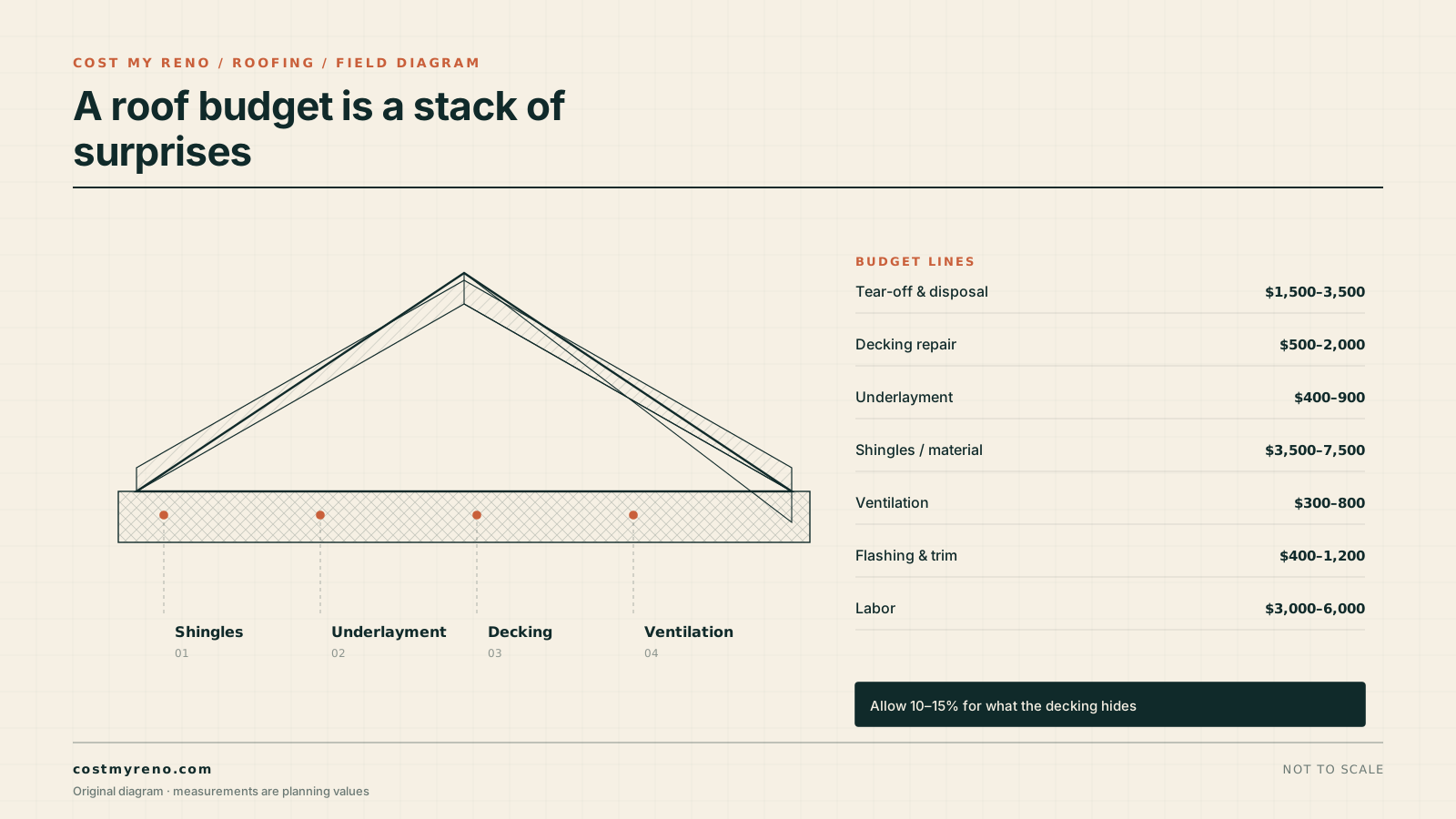
Budget the roof system, not the shingle. Tear-off, decking, underlayment, ice barrier, flashing, ventilation, permits, and disposal usually add 35 to 60% on top of the field shingle line, and the cheapest bid is usually the one that itemized the least.
Numbers to plan with
Pin the square count and the scope before you compare prices
A 22-square asphalt replacement is a five-figure decision in most US markets, and nearly every bid you receive will be organized differently. Fix three facts first: 22 squares of roof surface, one existing layer, and four penetrations. Every contractor prices those same facts, and everything after that is scope rather than price.
Installed architectural shingles run roughly $480 to $750 per square across US markets in 2026, which puts a 22-square job at $10,600 to $16,500 before deck repair and upgrades. Three-tab lands nearer $380 to $520 per square, luxury laminated $850 to $1,400, and standing-seam metal $1,100 to $2,000. These are planning ranges, not quotes. A Dallas suburb and a Boston suburb can differ by 30% on labor alone, and coastal markets add permit and product-approval costs on top.
Cost per square is a blunt instrument because it usually hides what is included. Two bids at $620 per square can differ by $4,000 once one includes ice barrier, drip edge, permit, and disposal while the other lists all four as extras. Normalize the scope into a shared line-item table, then compare totals.
An overlay, or re-cover, is legal in some jurisdictions when there is a single layer and the deck is sound, and it saves $70 to $140 per square in tear-off and disposal. It also traps heat, hides deck damage, shortens fastener life, and is prohibited by some local amendments and by many manufacturers' warranties. Treat the savings as conditional and get the code answer in writing before it appears in a contract.
Tear-off, layers, and disposal carry real weight
Tear-off runs $70 to $140 per square for a single layer, including loading and disposal. A second layer adds $35 to $70 per square because debris volume and labor both roughly double. On a 22-square roof that is $1,540 to $3,080 of the budget before a single new shingle is installed, and it is the line most likely to be described only as included.
Weight drives the container math. A square of torn-off architectural shingles weighs 350 to 450 lb, so 22 squares is 7,700 to 9,900 lb, or roughly 4 to 5 tons. A 20-yard dumpster is usually weight-limited before it is volume-limited at that density, which is why a 22-square tear-off often needs two pulls or a 30-yard container. Expect $450 to $750 per pull in most markets, higher where landfill tipping fees run above $80 per ton.
Ask where the debris goes and who pays the tipping fee. A bid that says dumpster included but does not name the container size, the number of pulls, and the disposal site is not comparable to one that does. Confirm protection as well: tarps over landscaping, plywood on the driveway, gutter protection, and a magnetic sweep of the lawn and gutters at the end of each workday.
One layer versus two also changes the shingle specification. Going over existing shingles requires longer fasteners sized to penetrate the deck by the depth the manufacturer specifies, and some products will not warrant an overlay at all. If a contractor proposes an overlay without measuring deck thickness or naming the fastener, the savings are being financed by a risk you carry.
Decking and framing: write the repair rule, not a guess
Nobody knows how much sheathing is soft until the old roof is off, which is exactly why the repair rule belongs in the contract before work starts. The workable approach is a unit price per 4 by 8 sheet installed, with photographs and written approval before the count exceeds an agreed threshold, usually one sheet beyond the allowance or a dollar cap such as $600.
Replacement sheathing runs roughly $110 to $225 per 4 by 8 sheet installed, depending on thickness, panel type, and how much cutting around penetrations is required. Rotten fascia, damaged rafters, and failed valley framing are separate line items and deserve their own unit prices rather than being folded into a vague contingency that nobody can audit afterward.
Re-nailing is a quiet line item that matters at the first windstorm. Codes and manufacturer instructions require fasteners driven flush and penetrating the deck to the specified depth, and older decks frequently have undersized or sparse nails. Re-nailing 22 squares adds a few hundred dollars of labor and costs far less than a wind claim denied for fastening.
Deck thickness and span are not the roofer's call. If sheathing is thinner than the shingle manufacturer's minimum, or the span looks unusual, that is a conversation with the building department rather than a change order signed in the driveway. Put the question in writing before demolition so the answer arrives while the roof is still intact.
The weather-control layer is where cheap bids lose water
Shingles shed most of the water. The layers beneath them control the water that gets past, and a bid that prices shingles per square while lumping everything else into one line is the bid most likely to substitute 15 lb felt for synthetic, skip the ice barrier, or reuse the old drip edge.
Synthetic underlayment costs roughly $9 to $16 per square installed and resists tearing better than felt during the wind-driven rain that always seems to arrive mid-project. Thirty-pound felt runs $15 to $22 per square, weighs more, and softens in heat. Neither product is wrong everywhere, but the bid should say which one you are buying and how many rolls it takes.
Ice-and-water shield belongs at eaves, in valleys, and anywhere snow sits. Adhesive membrane runs $43 to $65 per square installed at eave width and is required by many cold-climate jurisdictions. In warm markets it is often specified only in valleys, so confirm coverage by linear foot rather than assuming the word included means full eaves.
Planning ranges for the weather-control layer on a 22-square asphalt roof, installed. Use these to read a bid rather than to replace one; labor and material vary by region.
| Component | Unit | 2026 US planning range | What moves the number |
|---|---|---|---|
| Synthetic underlayment | per square | $9 to $16 | Product weight, roll count, deck texture |
| 30 lb felt underlayment | per square | $15 to $22 | Roll count, disposal, wind exposure |
| Ice-and-water shield | per linear ft of eave | $3.50 to $6.50 | Eave depth, valleys, local code, brand |
| Drip edge | per linear ft | $3 to $6 | Aluminum or steel, size, fascia condition |
| Valley metal | per linear ft | $12 to $25 | Valley length, style, whether decking is replaced |
| Pipe boot or vent flashing | each | $25 to $60 | Pipe size, lead or rubber, boot-only replacement |
| Chimney counterflashing | each | $350 to $900 | Masonry condition, height, whether a cricket is required |
Price the accessory lines before you judge the total
Work the example instead of trusting the per-square rate. A 22-square roof with 90 linear ft of eave, 60 linear ft of valley, 150 linear ft of drip edge, four pipe boots, and one chimney carries 90 ft of ice barrier at $5 for $450, 60 ft of valley metal at $18 for $1,080, 150 ft of drip edge at $4.50 for $675, 22 squares of synthetic underlayment at $12 for $264, four boots at $40 for $160, and one counterflashing at $600. That is $3,229 of weather-control work, which some bids bury inside the per-square rate and others omit entirely.
Starter strip, hip and ridge cap, and fasteners are separate again. Starter follows every eave and rake, cap follows every ridge and hip, and fasteners are specified per shingle and per wind classification. A proposal that prices field shingles per square and then itemizes these three lines is easier to audit than one blended number covering the whole roof.
Ventilation math that an inspector can check
Attic ventilation is specified as net free vent area against attic floor area. The base ratio is 1/150, and it relaxes to 1/300 when intake and exhaust are balanced and a Class I or II vapor retarder is installed. For a 2,200 sq ft attic floor, 1/150 is 14.7 sq ft of net free area, or 2,115 sq in, split roughly evenly between intake and exhaust.
Ridge vent typically provides about 18 sq in of net free area per linear foot, so 1,058 sq in of exhaust needs 59 linear ft of ridge, more than many roofs actually have. The balance usually comes from soffit vents: a standard 8 by 16 in vent nets about 56 sq in, so 19 vents spaced evenly along the eaves and never buried under insulation.
Mechanical ventilation changes both the arithmetic and the risk. A powered fan can depressurize an attic and pull conditioned air through ceiling bypasses when intake is inadequate, which turns a ventilation upgrade into a moisture and energy problem. If a bid adds a fan without adding intake, ask to see the net free area calculation behind it.
Ventilation also touches the warranty. Most manufacturers require ventilation consistent with the code and will point to an overheated deck as a cause of premature failure. The ventilation line is not decorative trim on the estimate; it is part of what keeps the product warranty enforceable five years later.
Permits, code upgrades, and the insurance question
Residential re-roof permits commonly run $150 to $650, and many jurisdictions require an inspection of the deck and underlayment before shingles go on. Skipping the permit saves a few hundred dollars and complicates a future sale, an insurance claim, and any warranty call. Ask who pulls the permit, and confirm the contractor is named on it rather than the homeowner.
Code upgrades appear in three places: underlayment requirements on low slopes, ice barrier in cold climates, and fastener schedules in high-wind zones. Asphalt shingles are limited to slopes of 2:12 and steeper, with double underlayment between 2:12 and 4:12, so a porch roof at 2.5:12 needs a different detail rather than a shingle. Wind-borne debris regions add product approval and nailing patterns that change labor, and that is a regional cost difference no national average captures.
Insurance brings its own vocabulary. Replacement cost value pays to rebuild; actual cash value pays depreciated value and leaves the gap with the homeowner. A deductible is not negotiable in most states, and a contractor who offers to absorb it creates a fraud exposure for both parties. When a claim is involved, request the adjuster's scope sheet and compare it line by line with the contractor's scope before signing anything.
Storm-chasing is a regional pattern worth naming. Hail-prone metros in Texas, Colorado, and the Midwest see more out-of-state crews and more supplement disputes, while coastal Florida and the Gulf add wind-mitigation documentation. None of that changes the line items. It changes how carefully you verify licensing, insurance, and the local permit record before the first bundle lands.
Payment schedule, warranty registration, and the final walk
A conventional residential schedule is a deposit of 10 to 30%, some states cap it, a progress payment after tear-off and dry-in, and a final payment after inspection and cleanup. Never pay the balance before the roof is dry, the site is swept, and the permit is closed. On larger jobs, get a lien waiver from the material supplier as well as the contractor.
Warranty has two halves that are easy to confuse. The workmanship warranty belongs to the contractor and typically runs 2 to 10 years. The manufacturer's limited warranty covers the product for 25 to 30 years on standard lines and longer on premium lines, usually prorated and usually excluding labor. Neither pays for a leak caused by a bad flashing detail in year three unless the workmanship warranty says so in writing.
Registration is the step homeowners forget. Many manufacturers require the warranty to be registered within 30 to 60 days of completion, and enhanced coverage often requires certified installation and may transfer only once to a second owner. Ask for the certificate, the product name, the color, the square count, and the install date, and keep two spare bundles labeled with the product code.
Walk the finished roof from the ground with the contractor: gutters clear, downspouts connected, ridge straight, no exposed nail heads, boots seated, and the magnetic sweep done twice. Photograph the finished roof, the labeled spare material, and the permit card. That file is what you will reach for in year four, when the only person who remembers the job is you.
Questions that come up on this job
What does a 22-square roof replacement cost in 2026?
Plan on $10,600 to $16,500 for architectural shingles at $480 to $750 per square, before deck repair and upgrades. Three-tab runs $8,400 to $11,400, luxury laminated $18,700 to $30,800, and standing-seam metal $24,000 to $44,000 on the same square count. Regional labor, tear-off layers, and weather-control scope move those ranges more than the shingle brand does.
Is a second layer over the existing shingles a good way to save money?
It saves $70 to $140 per square in tear-off and disposal, and it is legal only in some jurisdictions and only with one existing layer and a sound deck. It also hides deck damage, traps heat, requires longer fasteners, and can void a manufacturer's warranty. Get the local code answer and the product's overlay position in writing before treating the savings as real.
How much should I hold back for hidden deck damage?
Set aside $1,200 to $2,500 on a 22-square roof, and spend it against a written unit price rather than a verbal estimate. Replacement sheathing runs about $110 to $225 per 4 by 8 sheet installed. The contract should require photographs and approval before the count passes the allowance, so the number stays a budget rather than an open tab.
Does a new roof require a permit and an inspection?
Most jurisdictions require a re-roof permit, and many inspect the deck and underlayment before the shingles are installed. Fees typically run $150 to $650. An unpermitted roof can complicate a sale, an insurance claim, and a warranty call, and the contractor, not the homeowner, should be the named permit holder.
How long does the manufacturer warranty actually last?
Standard asphalt lines carry 25 to 30 year limited product warranties, with longer terms on premium lines. Coverage is usually prorated and excludes labor, and enhanced or transferable coverage often depends on certified installation and registration within 30 to 60 days. The contractor's own workmanship warranty, typically 2 to 10 years, is the one that covers installation errors.
Sources & further reading
References behind this guide
These sources support the safety, measurement, or industry conventions used above. Product instructions, approved plans, and local requirements control your project.