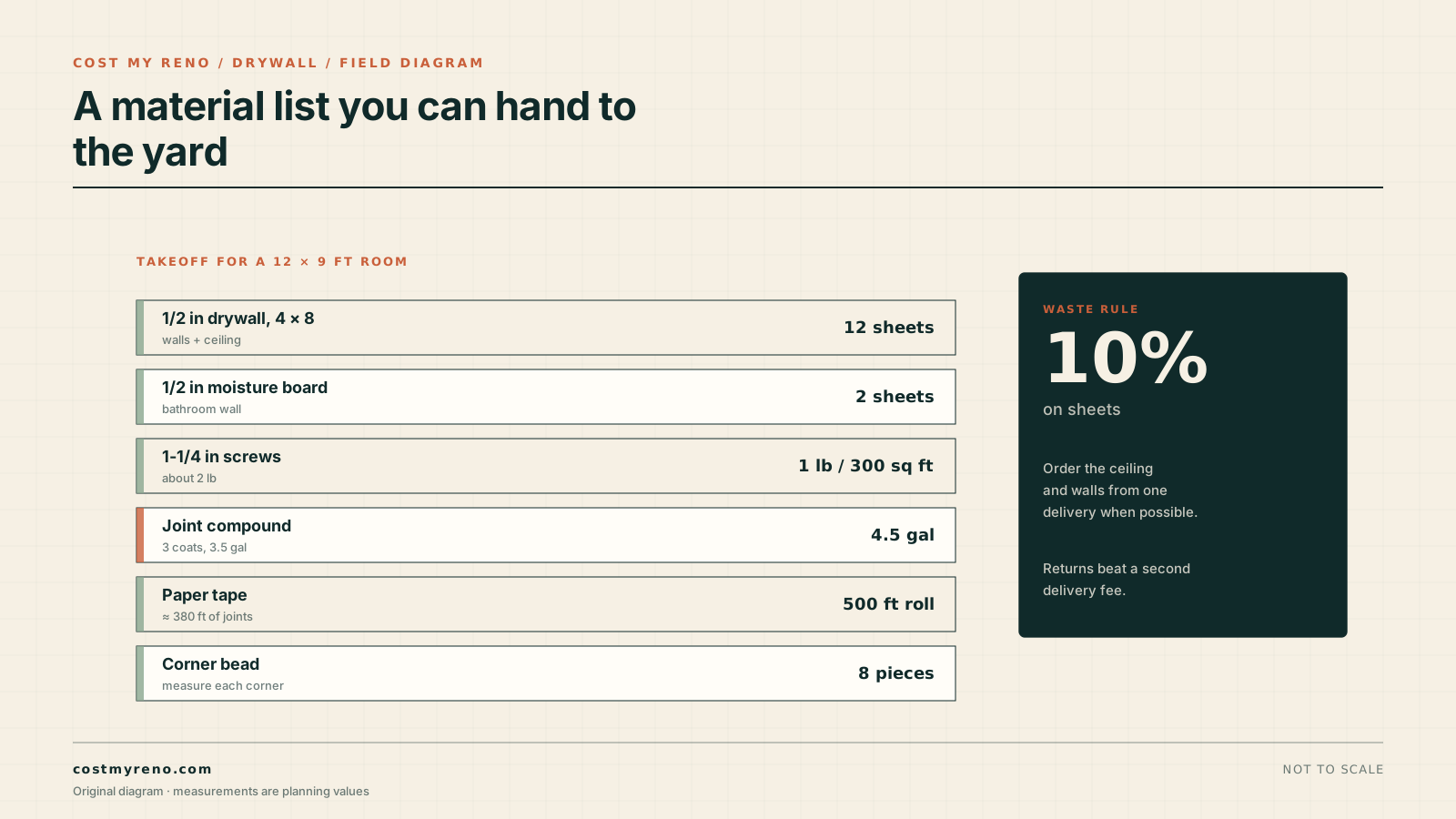
Sheet count is the area calculation. The rest of the order comes from the assembly, the fastener schedule, the promised finish level, and the number of corners.
Numbers to plan with
Confirm the Assembly Before You Price a Single Sheet
Two walls of identical size can require different board, different fasteners, and different joint treatment. A partition between a garage and a living room, a wall under a common corridor in a multi-family building, and a furnace closet each carry requirements that a generic 1/2 in panel does not satisfy. Start with the assembly number from the plans, the permit set, or the manufacturer listing, then read the layer schedule.
A one-hour rated wall commonly uses 5/8 in (15.9 mm) Type X with a published fastener schedule and specific joint treatment. A two-hour assembly may add a second layer, resilient channel, or mineral wool, and each of those changes the material list rather than just the labor line. Substituting a lighter panel or a shorter screw because the yard was out of stock removes the rating, and the inspector will ask for the listing that no longer applies.
Moisture-resistant board is a surface product, not a waterproofing system. It belongs where the assembly calls for it in bathrooms, laundry rooms, and behind tile substrates, and it still requires the same taping, priming, and sealing as standard board. Abuse-resistant board belongs where the wall takes impacts: garages, hallways, stairwells, and rental units. Neither product is a substitute for the other.
- Match board type to the assembly, not to the room name
- Keep the listing or assembly number with the permit documents for inspection day
- Never swap 5/8 in Type X for 1/2 in to save weight without written approval
Sheets: Convert Area, Then Add Waste by Room Shape
Add wall area, add ceiling area, subtract openings, then apply a waste factor to the net total. A 12×16 ft (3.66×4.88 m) room with 8 ft walls has a 56 ft perimeter, 448 sq ft of wall, 192 sq ft of ceiling, and about 61 sq ft of openings, for 579 sq ft net. At 10% waste that is 637 sq ft, or 20 sheets of 4×8.
The waste factor is a shape decision. A rectangular room with two openings runs at 10%. A room with a bay, a soffit, a tray ceiling, or five openings runs at 15%, because offcuts rarely match the next surface. A whole-floor job with many small rooms can reach 20% if each room is hung separately and remnants are not sorted.
Buy one spare panel per 1,000 sq ft (93 m²) of board, and one extra in any room with more than four corners. Store panels flat on a dry, level surface with support at the ends and middle. Board stored on edge bows under its own weight, and a bowed panel shows up as a wavy wall under raking light.
Fasteners: Length, Spacing, and How Many Pounds
Screw length follows board thickness and framing material. A 1/2 in panel on wood framing takes a 1-1/4 in (32 mm) screw; 5/8 in board takes 1-5/8 in (41 mm). On 20 to 25 gauge steel studs, 1/2 in board typically takes a 1 in (25 mm) Type S screw and 5/8 in takes 1-1/4 in, with the point type matched to the steel gauge. Too short and the head pops; too long and you spear cable or plumbing behind the wall.
Spacing is usually 12 in (305 mm) in the field and 8 in (200 mm) at panel edges on walls, with ceilings tightened to 7 or 8 in throughout in many published schedules. That difference matters at the register: a 4×8 ceiling panel at 7 in spacing needs roughly 70 screws, while the same panel at 12 in needs about 40. Multiply by the panel count before you buy boxes.
Screw quantity is easier to buy by weight. A pound of 1-1/4 in screws holds roughly 250 to 300 pieces depending on coating and head style. A 20-sheet room at 45 screws per panel uses about 900 screws, or 3 to 4 lb. Buy 5 lb and keep the remainder, because a stripped head or a missed stud consumes fasteners faster than the schedule predicts.
Fastener schedule for the common residential cases. Always confirm against the listed assembly and local code.
| Board thickness | Wood framing | Steel framing (20–25 ga) | Typical spacing |
|---|---|---|---|
| 1/2 in (12.7 mm) | 1-1/4 in (32 mm) | 1 in (25 mm) Type S | 12 in field, 8 in edges |
| 5/8 in (15.9 mm) | 1-5/8 in (41 mm) | 1-1/4 in (32 mm) Type S | 12 in field, 8 in edges |
| 5/8 in ceiling | 1-5/8 in (41 mm) | 1-1/4 in (32 mm) Type S | 7–8 in throughout |
| Second layer over 1/2 in | 1-5/8 in (41 mm) | 1-1/4 in (32 mm) Type S | 12 in field, 8 in edges |
Tape, Compound, and the Finish Level You Are Actually Buying
Finish levels run from Level 1, used in plenums and above ceilings, to Level 5, required where gloss paint or strong side light would reveal every ridge. Level 4 is the residential default: three coats over tape, with fasteners and joints covered. Level 5 adds a skim coat over the entire surface and typically adds 20% to 35% to the finishing labor and material on a room.
Compound quantity tracks joint length more than floor area. A 4.5 gal (17 L) bucket of all-purpose compound covers roughly 450 to 600 sq ft (42 to 56 m²) of board at Level 4 under normal conditions. Wide butt joints, a Level 5 skim, or a dry, hot room push consumption toward the low end and sometimes beyond it. Buy one extra bucket rather than stretching the last coat.
Use a setting-type compound for the first coat when you need to fill deep gaps or work fast, and a lightweight drying compound for finish coats that sand easier. Do not mix brands in the same bucket, and do not add water beyond the label ratio to stretch coverage: diluted compound shrinks more, sands softer, and telegraphs the joint edges.
- Level 4 needs three coats over tape, with fasteners spotted and joints wiped
- Level 5 adds a full skim coat and is worth it under gloss paint or wall-washing light
- One 500 ft (152 m) roll of tape covers roughly 500 to 700 sq ft of board at Level 4
Bead, Control Joints, Backing, and the Parts That Stop a Job
Corner bead comes in 8 ft and 10 ft lengths, in vinyl, paper-faced, and galvanized steel. Vinyl and paper-faced bead press into compound and suit most residential corners; steel bead resists impact in garages and commercial corridors. Fasten bead every 9 to 12 in (230 to 305 mm) on both flanges. A 10 ft length needs roughly 20 to 26 fasteners, so a 1,000-count box of bead screws covers about 400 ft of corner.
Control joints belong in long, unbroken planes where the framing and the board will move differently. Published guidance commonly calls for them at roughly 30 ft (9 m) intervals in ceilings and at transitions where framing changes, plus at the junction of a long wall and a structural element. A control joint is a deliberate straight break, not a crack: it is cut, backed, and finished like a joint so movement stays in one line.
The small parts are what turn a two-day job into three trips. Backing or blocking for butt joints, L-bead at exposed edges, J-trim at door and window returns, adhesive for ceilings or repair work, insulation where the assembly calls for it, and a roll of mesh tape for repairs all belong on the list. Add a tube of sealant for the gap at tub and floor transitions, and specify whether it is paintable.
Accessory quantities for a typical single-room job, with 2026 US price ranges before tax. Coastal metros run 15% to 30% above these; Midwest and Southeast yards run 10% to 20% below.
| Item | Quantity rule | For a 20-sheet room | 2026 price range |
|---|---|---|---|
| 1/2 in 4×8 panels | Order area ÷ 32, round up | 20 panels | $14–$20 each |
| 1-1/4 in screws | About 45 per panel on walls | 5 lb box | $25–$38 per 5 lb |
| Joint tape | 500 ft roll per 500–700 sq ft | 2 rolls | $6–$12 per roll |
| All-purpose compound | 1 bucket per 450–600 sq ft at Level 4 | 2 buckets (4.5 gal) | $18–$27 each |
| Vinyl corner bead | Linear feet of outside corners | 6 lengths at 10 ft | $4–$7 each |
| Bead screws | 20–26 per 10 ft length | 1 box of 1,000 | $9–$15 |
| Paper tape for repairs | One roll per floor | 1 roll | $5–$9 |
| Primer and sealer | 1 gal per 300–400 sq ft | 2 gal | $22–$38 per gal |
A Complete Order for a 12×16 ft Room
Run the full list on the 12×16 ft room from earlier: 579 sq ft net, 637 sq ft with 10% waste, 20 panels of 4×8. Walls take 448 sq ft and the ceiling 192 sq ft, so the ceiling accounts for about a third of the board and nearly half of the fastening labor, because ceiling spacing is tighter and every screw goes in overhead.
Estimate joint length before buying compound. A 12×16 room with 8 ft walls has roughly 190 linear ft of joint: 56 ft at the ceiling line, 56 ft at the floor, 32 ft of vertical corners, and the balance in butt joints and window returns. At 450 to 600 sq ft per bucket that is two buckets, plus a third if the walls get a Level 5 skim or if the butt joints run wide.
Finish the list with protection and access items: 2 mil poly and tape for doorways, a roll of rosin paper for finished floors, a box of shop rags, and a rented lift if the ceiling is 9 ft or higher. None of these appear in a square-foot estimate, and all of them show up on the receipt. Total material for the room typically lands between $900 and $1,500 in 2026 depending on board type, finish level, and region, before any labor.
- 20 panels of 1/2 in 4×8, plus one spare if the room has a tray ceiling
- 5 lb of 1-1/4 in screws, or 4 lb of 1 in Type S if the framing is steel
- Two 500 ft rolls of tape and two 4.5 gal buckets of compound
- Six 10 ft lengths of corner bead plus a 1,000-count box of bead screws
Questions that come up on this job
How many screws do I need per sheet of drywall?
A 4×8 wall panel at 12 in field spacing and 8 in edges takes roughly 40 to 45 screws. The same panel on a ceiling at 7 in spacing takes about 70. Buy by weight: a pound of 1-1/4 in screws is roughly 250 to 300 pieces, so a 20-panel room needs 3 to 5 lb.
How much joint compound does a room need?
Budget one 4.5 gal bucket per 450 to 600 sq ft of board at Level 4. Joint length matters more than floor area: a room with many butt joints and window returns consumes compound faster than an open rectangular room of the same size. Buy the third bucket for a Level 5 skim.
Can I use regular drywall in a bathroom?
Only where the assembly permits it and the surface stays dry. Moisture-resistant board is the usual choice for bathroom walls, but it is not waterproof and does not replace a shower waterproofing membrane. Tile substrates follow their own membrane and backer requirements.
What is the difference between Level 4 and Level 5 drywall finish?
Level 4 covers tape, fasteners, and joints with three coats. Level 5 adds a skim coat across the entire surface to remove differences in porosity and texture. Level 5 is specified under gloss paint, dark colors, and strong side light, and it adds roughly 20% to 35% to finishing cost.
Do I need corner bead on every outside corner?
Every outside corner that people can reach or see needs protection, which in practice means all of them. Bead provides a straight arris and a substrate for compound. Inside corners are taped, not beaded, and they need a consistent width so the joint reads as a line rather than a curve.
Sources & further reading
References behind this guide
These sources support the safety, measurement, or industry conventions used above. Product instructions, approved plans, and local requirements control your project.