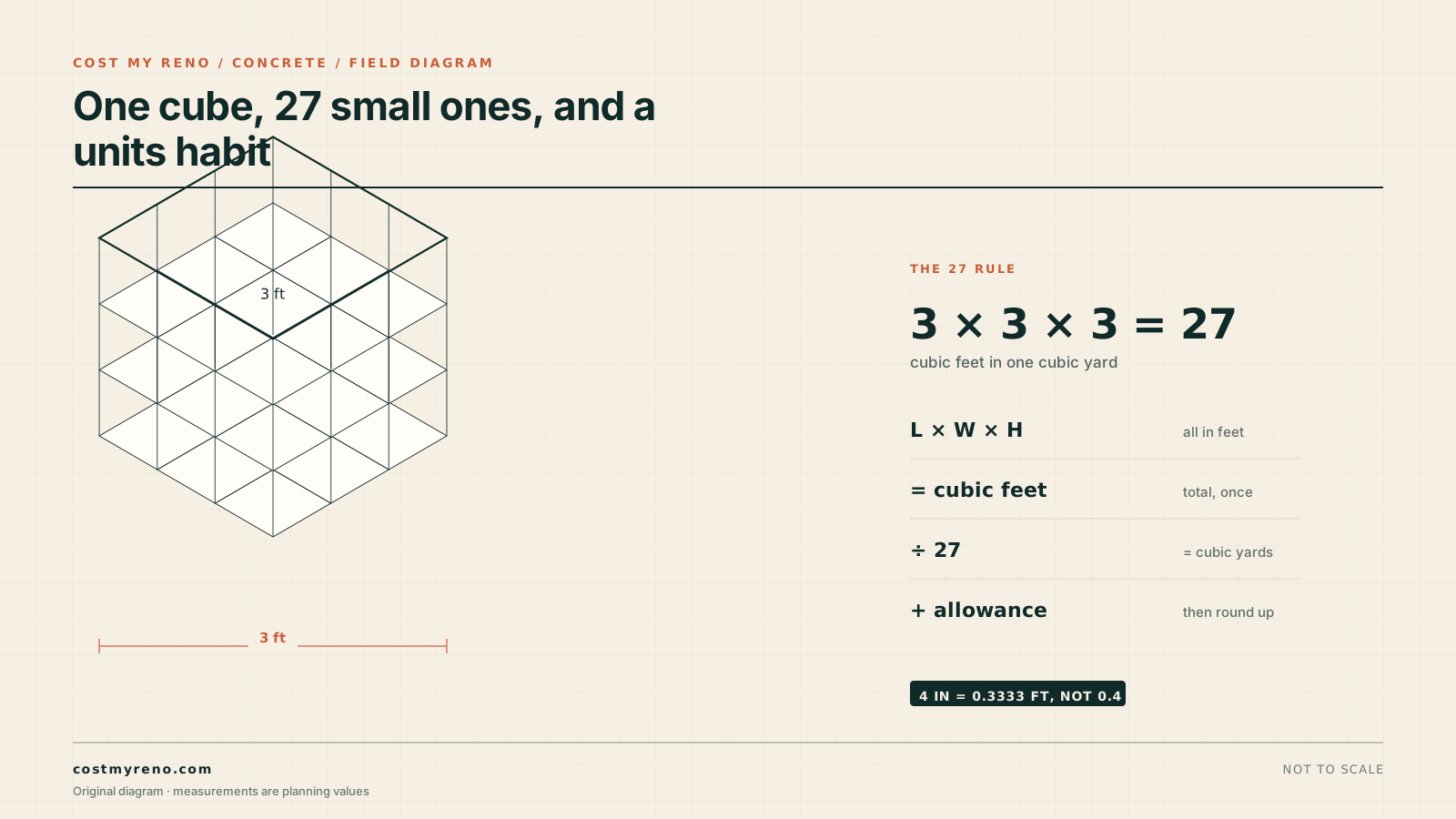
Convert every dimension to feet, multiply, divide the finished cubic-foot total by 27, and add the allowance only after the geometry is settled.
Numbers to plan with
Where 27 comes from, and why the units fight each other
A cubic yard is a cube 3 feet on each side. Three times three times three is 27, so one cubic yard holds 27 cubic feet. In inches, the same cube is 36 by 36 by 36, or 46,656 cubic inches, and a single cubic foot is 1,728 cubic inches. Those two numbers explain most conversion mistakes, because concrete thickness arrives in inches while length and width arrive in feet.
The metric equivalent is worth knowing for imported products and specifications: one cubic yard is 0.7646 cubic meters, and one cubic meter is 1.308 cubic yards. A 10-cubic-yard order is about 7.65 cubic meters. If a supplier quotes in either unit, confirm which one you are comparing before you compare prices.
Everything else in this guide is the same operation repeated: get all three dimensions into feet, multiply, total the cubic feet, and divide by 27. The only hard part is doing it consistently across a project with five different shapes and three different thicknesses.
Convert the thickness before you multiply
Divide inches by 12 before you touch the multiply key. Four inches is 0.3333 feet, five inches is 0.4167, six inches is 0.5000, and eight inches is 0.6667. The common error is treating 4 inches as 0.4 feet, which overstates volume by 20 percent: a 3-yard patio becomes a 3.6-yard order, and the extra 0.6 yards is $100 to $130 of concrete nobody needed.
The table below is worth keeping next to the calculator. Read it in either direction depending on what you already know.
Concrete thickness conversion and coverage
| Thickness | Decimal feet | Cubic yards per 100 sq ft | Square feet per cubic yard |
|---|---|---|---|
| 2 in | 0.1667 | 0.617 | 162 |
| 3 in | 0.2500 | 0.926 | 108 |
| 4 in | 0.3333 | 1.235 | 81 |
| 5 in | 0.4167 | 1.543 | 65 |
| 6 in | 0.5000 | 1.852 | 54 |
| 8 in | 0.6667 | 2.469 | 40.5 |
| 10 in | 0.8333 | 3.086 | 32.4 |
| 12 in | 1.0000 | 3.704 | 27 |
Irregular shapes: split them, never average them
A 300-square-foot patio at 4 inches is three times 1.235, or 3.70 cubic yards. Going the other way, a 12-inch-wide by 12-inch-deep footing that needs 2 cubic yards will run 54 linear feet, because 2 cubic yards is 54 cubic feet and that section is exactly 1 cubic foot per linear foot.
An L-shaped patio is two rectangles. A 20 by 12 foot leg plus a 10 by 8 foot leg is 240 plus 80, or 320 square feet, which at 4 inches is 106.7 cubic feet and 3.95 cubic yards. Averaging the two widths to make one rectangle produces a number that does not describe the shape and cannot be checked against the forms.
Footings and piers need their own formulas. A rectangular footing 18 by 18 inches and 12 inches deep is 1.5 by 1.5 by 1.0 feet, or 2.25 cubic feet. A round pier is pi times the radius squared times the height: a 12-inch-diameter tube 4 feet deep is 3.14 times 0.25 times 4, or 3.14 cubic feet, about 0.12 cubic yards. An 8-inch tube at the same depth is 1.40 cubic feet. Six 12-inch piers at 4 feet deep total 18.8 cubic feet, or 0.70 cubic yards.
Steps are a stack of boxes, not a ramp. A 4-foot-wide step with a 12-inch tread and a 7-inch riser is 4 by 1 by 0.583 feet, or 2.33 cubic feet. Three of them are 7 cubic feet. Measure each riser from the top of the one below it, and do not count the volume twice. Subtract only true voids: a formed opening, a plumbing sleeve, a column blockout. Soil that will simply be covered is not a void, and treating it as one is how orders come up short.
Going the other way: yards to feet and bags to yards
Small jobs are often poured from bags, and the bag label states yield in cubic feet. An 80-pound bag of concrete mix yields about 0.60 cubic feet, a 60-pound bag about 0.45, a 50-pound bag about 0.375, and a 40-pound bag about 0.30. Divide the required cubic feet by the yield to get the bag count, then round up to whole bags.
Bag yield and the equivalent number of bags per cubic yard
| Bag size | Yield (cu ft) | Bags per cubic yard | Bags for half a yard |
|---|---|---|---|
| 80 lb | 0.60 | 45 | 23 |
| 60 lb | 0.45 | 60 | 30 |
| 50 lb | 0.375 | 72 | 36 |
| 40 lb | 0.30 | 90 | 45 |
A full takeoff, worked line by line
Take a real project: a 24 by 16 foot driveway apron at 6 inches, a 20 foot long by 18 inch wide by 12 inch deep footing, and six 12-inch piers 3 feet deep. Do the apron first. Twenty-four times sixteen is 384 square feet. Six inches is 0.5 feet, so 384 times 0.5 is 192 cubic feet, which is 7.11 cubic yards. Note that the thickness conversion happened before any multiplication, so no rounding crept in.
The footing is next. Eighteen inches is 1.5 feet and twelve inches is 1.0 foot, so each linear foot of footing is 1.5 cubic feet. Twenty feet is 30 cubic feet, or 1.11 cubic yards. The six piers are pi times 0.5 squared times 3, or 3.14 times 0.25 times 3, which is 2.36 cubic feet each. Six of them are 14.14 cubic feet, or 0.52 cubic yards.
Total the cubic yards, not the rounded subtotals: 7.11 plus 1.11 plus 0.52 is 8.74 cubic yards. Add 5 percent for the flatwork and 10 percent for the formed pieces, and the order lands near 9.4 cubic yards. Round to the plant's quarter-yard increment and the call is for 9.5 yards. Every number in that chain can be reproduced by a second person with the same tape measure, which is the point of writing it down.
- Apron: 24 × 16 × 0.5 = 192 cu ft = 7.11 cu yd.
- Footing: 20 × 1.5 × 1.0 = 30 cu ft = 1.11 cu yd.
- Six piers: 6 × 2.36 = 14.14 cu ft = 0.52 cu yd.
- Subtotal 8.74 cu yd, allowance to 9.4, order 9.5.
Where the arithmetic stops and the order begins
One cubic yard is 45 bags of 80-pound mix, which is 3,600 pounds of material to carry, mix, and place. That is why bag mix stops making sense somewhere around half a yard. A 4 by 4 foot pad at 4 inches is 5.33 cubic feet, nine bags, and a reasonable afternoon. A 10 by 10 foot pad at 4 inches is 33.3 cubic feet, 56 bags, and a very long day.
Bag yields vary by product. A high-strength mix, a fast-setting mix, and a sand mix all have different yields and different intended applications. Read the bag, not the shelf tag, and do not assume a 50-pound bag of one product covers the same area as an 80-pound bag of another.
Geometry gives you a number to two decimal places, and none of that precision survives contact with a subgrade. Add 5 percent on flatwork over a proof-rolled base, 10 percent on formed footings, and up to 15 percent where concrete goes against rough excavation. Then round up to whatever increment the plant sells, usually a quarter yard. The last quarter yard costs less than a cold joint and far less than a second truck.
Before you call, check the total against a sanity figure. A cubic yard covers 81 square feet at 4 inches, so a 1,000-square-foot slab should land near 12.3 yards before allowance. If the takeoff says 30 yards for that slab, thickness was entered in inches twice or a dimension got doubled. If it says 3 yards, something was divided by 270. The conversion is exact, and that is exactly why an absurd result usually points to a units error rather than a strange slab.
Finally, confirm what the plant is counting. Some quote cubic yards as batched, some round the load to the nearest quarter, and some price a minimum regardless of volume. The arithmetic is yours to get right. The commercial terms are theirs to disclose, and both belong in the same conversation before the truck is dispatched.
Questions that come up on this job
How many cubic feet are in a cubic yard of concrete?
Exactly 27. A cubic yard is 3 feet by 3 feet by 3 feet, and 3 × 3 × 3 = 27. In inches that is 46,656 cubic inches, while a cubic foot is 1,728 cubic inches.
How many square feet does one yard of concrete cover?
81 square feet at 4 inches, 65 square feet at 5 inches, and 54 square feet at 6 inches. Divide 27 by the thickness in feet to get coverage for any other thickness.
How many bags of concrete equal a cubic yard?
45 bags of 80 lb mix, 60 bags of 60 lb, 72 bags of 50 lb, or 90 bags of 40 lb, based on typical yields. Confirm the yield printed on the bag you are buying, because high-strength and fast-setting products differ.
Why did my concrete order come out 20 percent high?
The usual cause is entering 4 inches as 0.4 feet instead of 0.3333. Another is converting each dimension to yards separately and rounding along the way. Convert inches to feet, multiply all three dimensions, total the cubic feet, and divide once at the end.
Should I convert thickness to yards first?
No. Convert thickness to feet, multiply length by width by thickness, then divide the total cubic feet by 27. Converting each dimension to yards before multiplying compounds rounding error and makes the arithmetic much harder to check.
Sources & further reading
References behind this guide
These sources support the safety, measurement, or industry conventions used above. Product instructions, approved plans, and local requirements control your project.