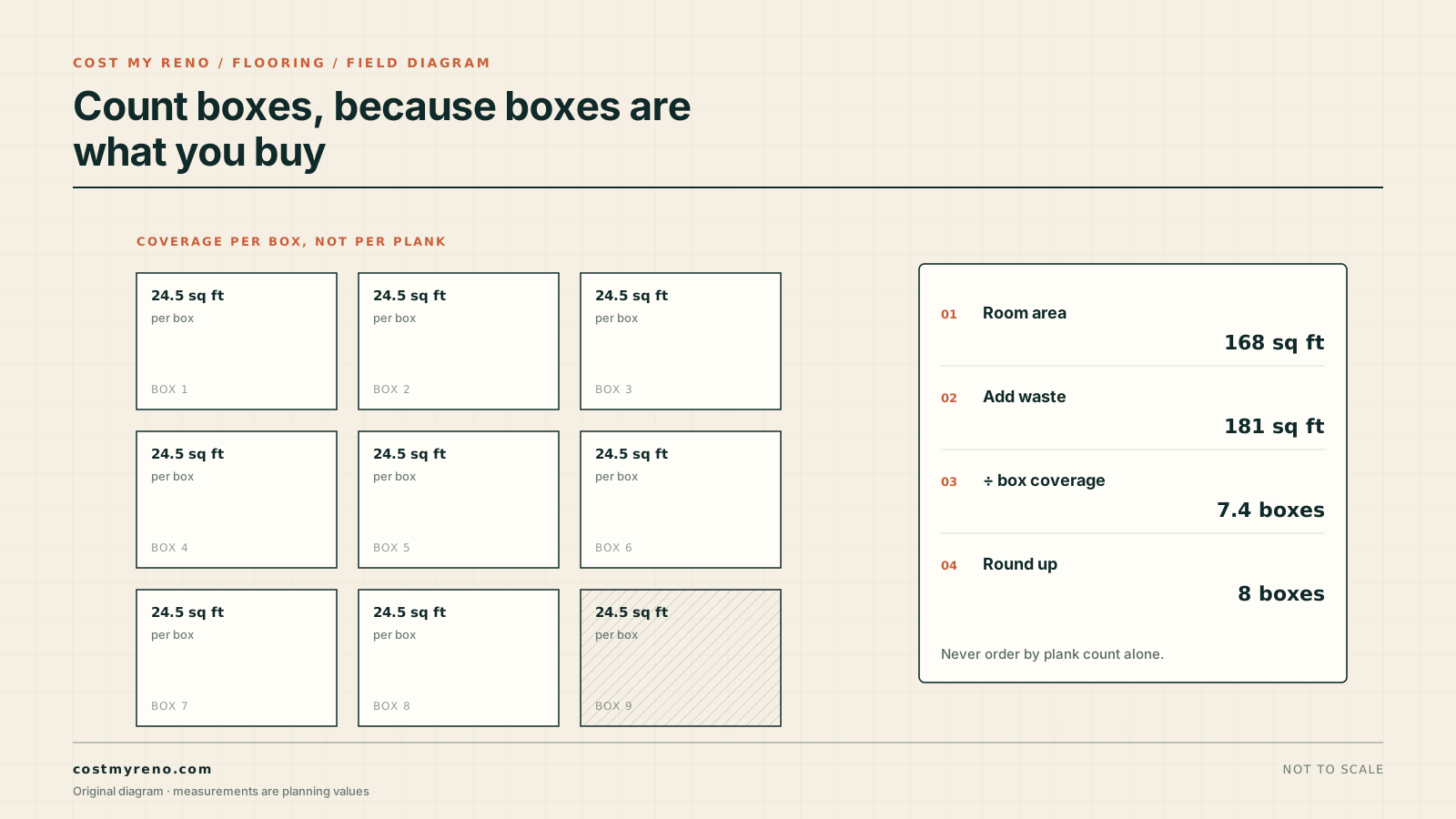
Waste-adjusted area divided by the printed carton coverage, rounded up once, is the order. Price per square foot, pallet discounts, and spare boxes are separate decisions.
Numbers to plan with
Read the carton label before you read the price tag
Four numbers on the carton decide the order: coverage in square feet, piece count, actual plank or tile dimensions, and shipping weight. Coverage is the only one that enters the arithmetic, and it is almost never a round number. Real labels read 23.8, 24.06, 31.1, or 17.6 sq ft. Using 24 because it is close looks harmless until the order lands one carton short.
The difference compounds on larger floors. At 360 sq ft of order area, a 24.0 sq ft assumption gives exactly 15 cartons, while the true 23.8 figure gives 15.13 and requires 16. That is a $60–$130 miss caused entirely by rounding the label. At 330 sq ft the same mistake is invisible, which is why the error survives until the job where it matters.
Photograph the end panel and the retailer's spec sheet before the material leaves the store. Product codes and coverage change between production runs, and the box in your garage six months later may not match the one on the website. Weight matters too: a carton of plank runs 40–60 lb and a carton of large-format tile can run 55–80 lb, which changes how many boxes you carry up a flight of stairs in one trip.
The rounding rule: round once, at the very end
The method is three steps. Multiply measured net area by one plus the waste percentage to get order area. Divide order area by the printed coverage per carton. Round the result up to the next whole carton. Do not round the area, do not round the coverage, and do not round twice.
A short example shows why the order of operations matters. A 300 sq ft room at 10% gives 330 sq ft. With 25.0 sq ft cartons, 330 ÷ 25 = 13.2 cartons. Thirteen cartons purchase 325 sq ft, which is 5 sq ft short of the order target before a single board is damaged. The correct answer is 14 cartons, and the fractional 0.2 is the entire warning.
Watch the percentage conversion as well. A 10% allowance multiplies by 1.10, giving 330 sq ft. Dividing 300 by 0.90 gives 333.3 sq ft, which is an 11.1% allowance dressed up as 10%. The error is small on one room but compounds across a whole house and can flip a carton count at the boundary.
Keep both the net area and the order area on the worksheet in separate columns. When a bid, an invoice, and a return receipt disagree, those two numbers tell you which stage introduced the difference. A single blended number cannot be audited by anyone, including the person who wrote it.
Two cartons at the same price per square foot, different invoices
Price per square foot is a derived number, and it hides carton geometry. The table compares four products against a 330 sq ft order target. Product B is the cheapest per square foot and ties Product A on total cost while leaving more material in the garage. Product C has the lowest invoice and the most leftover. Product D is the most expensive on both counts.
Read the last two columns together. Product C costs $821.04 and delivers 342.1 sq ft, of which 12.1 sq ft is package rounding. Product A costs $11.96 more and delivers 8.9 sq ft less. If the installer needs two spare cartons for a repair reserve, the comparison changes again, because the spare is purchased in whole cartons, not square feet.
Four carton configurations priced against the same 330 sq ft order target. Totals exclude tax, delivery, and underlayment.
| Product | Coverage per carton | Price per carton | Effective $/sq ft | Cartons needed | Purchased area | Material total |
|---|---|---|---|---|---|---|
| A | 23.8 sq ft | $59.50 | $2.50 | 14 | 333.2 sq ft | $833.00 |
| B | 20.0 sq ft | $49.00 | $2.45 | 17 | 340.0 sq ft | $833.00 |
| C | 31.1 sq ft | $74.64 | $2.40 | 11 | 342.1 sq ft | $821.04 |
| D | 17.6 sq ft | $45.76 | $2.60 | 19 | 334.4 sq ft | $869.44 |
Not everything is sold by the carton
Tile is sold by the carton but specified by the piece. A 12 × 24 in tile is 2 sq ft per piece; six pieces per carton is 12 sq ft. A 300 sq ft floor at 10% needs 330 sq ft, or 27.5 cartons, which rounds to 28 cartons and 336 sq ft. Add 2–5% for breakage and future repairs on top of the cutting allowance, because tile chips at the edge and a discontinued dye lot cannot be matched later.
Carpet moves in square yards, not square feet. One square yard is 9 sq ft, so 300 sq ft is 33.33 sq yd. Pad is ordered on the same basis, and both are cut from a roll, so the seam diagram controls the real quantity. A 12 ft roll serving a 15 ft wide room wastes more than a percentage suggests, while a 15 ft roll can cover the same room with a single cut.
Sheet vinyl is sold by the linear foot from a 6 ft or 12 ft roll. A 12 ft roll cut at 20 linear ft yields 240 sq ft, and the leftover 4 ft strip is unusable for the main field. Hardwood is sold by the square foot in random-length bundles, with trim and stair nosing priced by the linear foot. Convert every purchase to square feet and linear feet on one worksheet, then convert back to the units the counter actually sells.
Spare stock, batch codes, and return windows
Plan one sealed carton as a repair reserve for plank, laminate, and rigid core, and two to three cartons for tile in a room of 200 sq ft or more. The reserve is not the same as the cutting allowance. Cutting allowance is consumed during installation; the reserve stays sealed until a chair leg, a dropped tool, or a plumbing leak creates a repair.
Record the batch or lot code from every carton, not just the first one. Retailers occasionally ship mixed lots in a single order, and the mismatch shows up as a visible color shift across a doorway six months later. Product lines turn over in roughly three to seven years, and a discontinued SKU with a different lot is not a repair, it is a patch.
Return terms decide whether a generous order is cheap or expensive. Most retailers accept unopened full cartons within 30–90 days with a receipt. Special orders commonly carry a 0–25% restocking charge, and freight is rarely refunded. Pallet purchases can save 3–8% but are frequently non-returnable, which converts a small saving into a large piece of permanent inventory.
The order worksheet to hand to the counter
A counter employee can build an accurate order in two minutes from six lines. Without them, the conversation becomes a guess about room size and a debate about waste, and the person who loses is the one who has to come back for a matching carton.
Bring the room list with net square footage, the chosen waste percentage and resulting order area, the printed coverage per carton, the rounded carton count, the purchase unit, and the price per unit before tax. Ask the counter to confirm the coverage figure against the physical box, not the shelf tag, and to note the batch code on the receipt.
Before paying, confirm delivery terms: curbside versus inside placement, whether the driver will carry upstairs, and how much time you have to inspect for damage. A pallet dropped at the end of a 60 ft driveway is a legitimate delivery, and moving 1,200 lb of plank into the house is a line item nobody budgeted.
- Net area by room, with closets and doorways included and true voids deducted
- Waste percentage and the order area it produces
- Printed coverage per carton, photographed rather than remembered
- Carton count rounded up once, with the fractional result written beside it
- Purchase unit and unit price before tax, delivery, and tax
- Return window, restocking fee, and batch code recorded on the receipt
Questions that come up on this job
Do I always round up to the next box?
Yes. A fractional carton is not a purchasable unit, and rounding down removes material the layout has already counted on. If the result is 13.05, the order is 14. The only exception is a product sold by the square foot from a continuous roll, where the cut length is set by the seam plan instead.
Why did 10% waste not add an extra box?
Because carton coverage absorbs it. On a 300 sq ft floor with 23.8 sq ft cartons, both 5% and 10% round up to 14 cartons. The allowance is real, but the package size hides it. Check the count at each percentage before assuming a lower allowance saves money.
How many spare boxes should I keep?
One sealed carton for plank, laminate, or rigid core, and two to three for tile in a room of 200 sq ft or more. Keep them from the same batch, labeled with the room and date. A spare carton is cheaper than a discontinued product and a mismatched patch.
Is it cheaper to buy a full pallet?
Sometimes, by roughly 3–8%, but pallet pricing often comes with a no-return condition and a delivery that lands at the curb. Compare the pallet total against the exact carton count you need, including the spare, and confirm the return terms before committing.
What if the store's website coverage differs from the box?
Trust the physical carton and the manufacturer's current specification sheet, then ask the counter to confirm in writing. Websites lag production changes, and a coverage difference of 0.5 sq ft per carton is enough to change the count on a large order.
Sources & further reading
References behind this guide
These sources support the safety, measurement, or industry conventions used above. Product instructions, approved plans, and local requirements control your project.