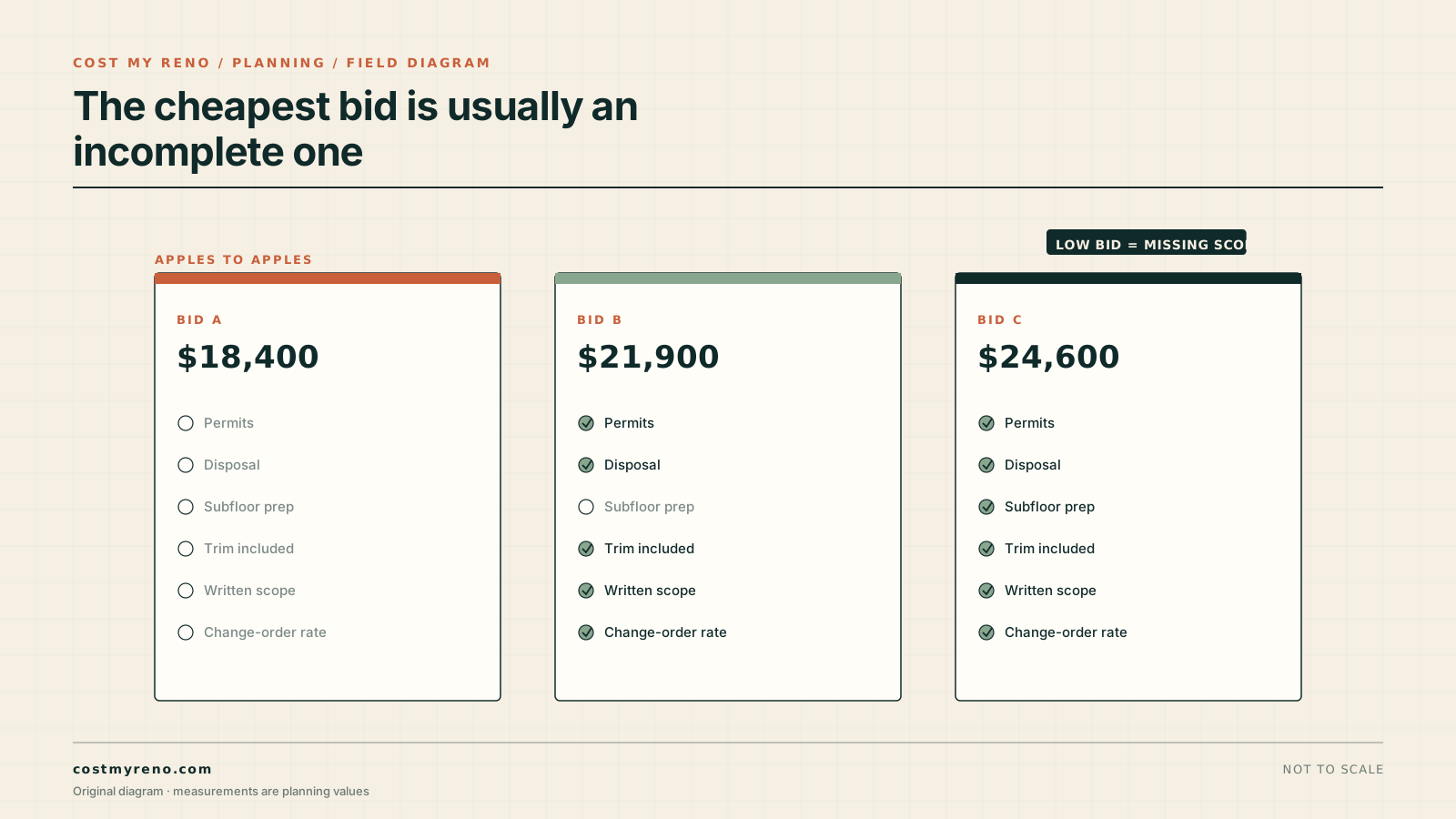
A bid total means nothing until every line has the same scope, the same allowance basis, and the same exclusions priced back in. Compare adjusted totals, then judge the paperwork.
Numbers to plan with
One Scope Sheet, Priced Three Times
Most bid comparisons fail before the first number is read, because each contractor priced a different project. One bidder assumed the old flooring stays, another included disposal, a third allowed $4,000 for cabinets while the homeowner had already chosen a $9,500 line. The totals differ by thousands and none of the difference is margin. The fix is a numbered scope sheet written before anyone visits, with 40 to 60 lines covering demolition, protection, rough-in, finishes, trim, cleanup, permits, and disposal.
Give every line one of three statuses: included, excluded, or allowance with a dollar figure. Send it as a PDF with the request for proposal and ask bidders to strike through anything they cannot meet, initial the change, and return the marked sheet with the price. A refusal to work from a written scope is useful information before you spend an hour reading a bid.
The arithmetic is where the lesson lands. Three bids on a 180 sq ft kitchen come in at $18,400, $22,750, and $26,900. The low bid excludes the $650 permit, $480 in disposal, and $300 cabinet delivery, and it carries a $4,000 cabinet allowance against the $9,500 selection the owner already made. Add those four items back and the low bid becomes $25,330. The middle bid, at $22,750 with a $9,000 allowance and a permit included, is the actual cheapest complete price. Nobody lied; the documents simply did not describe the same job.
- Write the scope sheet before the first site visit, not after the first bid arrives
- Require included, excluded, or allowance on every line, with no blank cells
- Have bidders mark deviations on your sheet and initial them rather than retyping the scope
The Comparison Table That Makes Gaps Visible
Build the table with scope lines down the left, one column per bidder, and a variance note at the end. Transcribe each bid exactly as written, vague language included, then work four passes: normalize allowances to your actual selection, price the exclusions yourself, reconcile quantities, and adjust for schedule or contingency differences.
Quantities hide in plain sight. One bid may carry 320 sq ft of tile for a 240 sq ft floor with 10% waste, another 260 sq ft with no allowance for cuts. A cabinet line priced by the linear foot cannot be compared to one priced by the box until both are converted to the same layout. Ask for the takeoff behind any line worth more than 5% of the contract.
A gap that appears in one bid is not automatically an omission by the low bidder. Occasionally the higher bid includes work the project does not need, such as a second layer of subfloor. Resolve the line in writing with every bidder before ranking anything, and record the answer next to the number.
Adjust the bids before ranking them. The far-right column is the only number worth comparing, and it is built from your scope rather than the contractor's assumptions.
| Scope line | Bid A | Bid B | Bid C | Adjustment applied |
|---|---|---|---|---|
| Base contract price | $18,400 | $22,750 | $26,900 | As written |
| Permit and inspection fees | Excluded | $650 included | $780 included | Add $650 to A |
| Demolition and disposal | Haul away by owner | $480 included | $480 included | Add $480 to A |
| Cabinet allowance | $4,000 | $9,000 | $9,500 | Raise A by $5,500 |
| Cabinet delivery and assembly | Excluded | $300 included | $300 included | Add $300 to A |
| Electrical rough-in | $1,850 | $2,400 | $2,150 | Check circuit count |
| Adjusted total | $25,330 | $22,750 | $27,110 | Rank on this column |
Allowances, Unit Prices, and the Sentences That Cost Money
An allowance is a placeholder, and a placeholder without a basis is a future argument. A usable allowance names the quantity, the unit, and the quality level. An allowance written as $1,200 for tile is not comparable to 120 sq ft of porcelain at $4.50 per sq ft with overage billed at invoice plus 15%. The second version survives a change of mind; the first becomes a negotiation at the worst moment.
Unit prices handle what nobody can see yet. Ask each bidder to state a price for concealed conditions before demolition: drywall repair per square foot, framing repair per hour, subfloor replacement per sheet, and the labor rate for added electrical or plumbing. In 2026 US markets those unit prices commonly run $3.50 to $7 per sq ft for drywall repair, $95 to $140 per hour for finished carpentry, and $4 to $9 per sq ft for subfloor replacement, with coastal metros 15% to 30% higher.
The phrases that cost money are short: as needed, per code, to match existing, typical, and to be determined. Each transfers a decision to the jobsite, where your leverage is lowest. Ask for a number or a named product before signing, and keep the reply with the contract.
- An allowance needs a quantity, a unit price, a product grade, and a rule for overage
- Get written unit prices for concealed conditions before demolition starts
- Replace every as needed and to match existing with a measurable commitment
Score Each Bid Against Twelve Red Flags
Price is one input; paperwork is the other. Score each bid on twelve items, awarding 0 for clear and documented, 1 for vague or promised later, and 2 for missing or refused. Double the weight on license, insurance, and payment terms, because those three failures are the ones that turn a bad job into an expensive legal problem.
Add the weighted points and read the result against thresholds rather than instincts. A score of 0 to 6 is a bid you can work with. Seven to twelve needs every vague item resolved in writing before signing. Thirteen or more is a bid to decline regardless of price, since the missing documents usually predict how the job will be run.
Treat a price that sits more than 20% below the median as a scored item, not a bargain. Sometimes a small owner-operated crew is genuinely cheaper because overhead is low. Just as often the difference is an omitted scope line, an uninsured crew, or a deposit that funds the previous job. Ask directly which scope lines were left out to reach the number.
Twelve checks, weighted. Three items carry double weight because a failure in any of them can cost more than the entire contract.
| Check | What to verify | Weight |
|---|---|---|
| Written scope | Line-by-line scope matching your sheet | 1 |
| License | Number verified on the state or local board lookup | 2 |
| Insurance | General liability and workers compensation certificate | 2 |
| Payment schedule | Tied to milestones, not calendar dates | 2 |
| Permit responsibility | Contractor pulls the permit in their name | 1 |
| Start and completion dates | Specific dates plus weather allowance | 1 |
| Change order process | Written approval before work, price and schedule stated | 1 |
| Warranty | Workmanship term in writing, exclusions named | 1 |
| Lien waivers | Conditional with each draw, final at close | 1 |
| References | Three similar jobs completed in the last 24 months | 1 |
| Subcontractor list | Named trades and their insurance | 1 |
| Price versus median | Explanation required beyond 20% below | 1 |
Payment Milestones That Keep Your Money in Your Account
A deposit is normal; a large deposit is not. Residential contracts in 2026 commonly start with 10% to 33% down, and several states cap the initial payment on home improvement work. Anything above a third before materials arrive should be questioned, and cash-only requests should end the conversation.
Progress payments belong to completed phases, not calendar dates. A rough-in draw should follow the rough-in inspection, not the arrival of the invoice. Hold 5% to 10% as retainage until the punch list is finished, and make the final payment contingent on a final inspection, a signed punch list, and unconditional lien waivers from the contractor and every subcontractor who supplied labor or material.
Never pay for material that has not been delivered or stored under your control. If a long-lead item such as cabinets requires a deposit, ask for the supplier invoice, confirm the order is in your name, and get a stored-materials clause that identifies the goods and where they sit. Federal rules also give you three business days to cancel a contract over $25 signed at your home, which is one more reason not to sign on the first visit.
A payment structure that keeps leverage with the owner through the end of the job. Percentages are typical for residential remodeling in 2026, not a legal requirement.
| Milestone | Typical share | Trigger | Document to collect |
|---|---|---|---|
| Contract signing | 10%–33% | Signed contract and permit application | Receipt and contract copy |
| Rough-in complete | 20%–25% | Framing, electrical, and plumbing inspected | Inspection card or approval |
| Drywall and primer | 20%–25% | Board hung, finished, and primed | Conditional lien waiver |
| Fixtures and finishes | 20%–25% | Cabinets, counters, and trim installed | Conditional lien waiver |
| Final payment | 5%–10% | Punch list signed and final inspection passed | Unconditional final waivers |
What a Change Order Must Contain Before You Sign
A change order is a small contract and needs the same discipline as the original. It should state what is changing and why, the price with labor and material separated, the schedule effect in working days, the revised contract total, the date, and both signatures. It should also say that all other original terms remain in force, so a change does not quietly reopen the payment schedule.
Price the change before the work happens, not after. A contractor who must start immediately for safety can proceed with verbal approval, but the written order should follow within 24 hours and should note that the work was authorized verbally and why. Anything else sets a precedent where scope grows first and numbers arrive later.
Track cumulative changes against the contract, not one at a time. Three orders of $400 feel minor; $1,200 against a $22,750 contract is 5%, and that is the level where a homeowner should ask whether the scope document was wrong. When cumulative changes pass 10% to 15%, re-baseline the scope, the budget, and the remaining schedule in one conversation rather than four.
- Description of the change and the reason it is necessary
- Price broken into labor, material, and any permit or design fee
- Schedule impact stated in working days, not someday
- Revised contract total after the change
- Both signatures, printed names, and the date
- A line confirming that all other original terms still apply
Schedule, Warranty, and the Five Checks Before You Sign
A credible schedule names a start date, a substantial completion date, and the conditions that extend both. Weather days, inspection waits, and long-lead material delays are legitimate; a schedule without dates is not a schedule. Ask what substantial completion means for your project, because the gap between usable and finished is where disputes live.
Workmanship warranty terms commonly run one year from substantial completion; manufacturer warranties are separate and often longer. Read what voids coverage: owner modifications, work by other trades, or movement from a structural change. Register product warranties yourself, since the contractor may not after final payment.
Five checks close the loop: the license number verified on the issuing board's own lookup rather than on a business card, an insurance certificate received directly from the broker, a permit applied for in the contractor's name before demolition, three references with comparable scope from the last two years, and a full read of the contract including cancellation and dispute terms.
- License verified through the issuing board, not through the contractor's own paperwork
- Insurance certificate received directly from the broker or insurer
- Permit applied for in the contractor's name before demolition
- Three references with comparable scope, not three happy neighbors
- Contract read in full, including cancellation and dispute resolution terms
Questions that come up on this job
How many contractor estimates should I get?
Three written bids on the same scope sheet is the practical minimum for a project above a few thousand dollars. Add a fourth from a specialist when the work includes structural changes, an electrical service upgrade, or a plumbing relocation, because general remodelers often price those lines as allowances rather than as work they control.
Is the lowest bid always a warning sign?
No, but a bid more than 20% below the median needs a specific explanation. A small crew with low overhead can legitimately be cheaper. An omitted permit, missing disposal, uninsured labor, or an allowance set below the selections you have already made are the more common reasons, and each one is visible on the scope sheet if you look.
Should I pay a deposit before the contract is signed?
No. The deposit belongs in the contract, with the amount, the trigger, and the refund conditions written down. Paying before signature gives away the only leverage you have over the terms. If a contractor needs a materials deposit, ask for the supplier invoice and confirm the order is in your name.
What if a contractor refuses to give a written contract?
Walk away. Written contracts are required for home improvement work in many states, and a refusal is a reliable indicator of how change orders and warranty claims will be handled. A one-page proposal with a signature line is not a substitute for scope, payment terms, and cancellation rights.
Can I negotiate a contractor's estimate?
Yes, but negotiate scope rather than the same scope at a lower price. Ask what a line costs to remove, choose a different product tier, or phase the work. A discount on identical scope usually comes out of labor quality, supervision, or the contingency the contractor needs for hidden conditions.
Sources & further reading
References behind this guide
These sources support the safety, measurement, or industry conventions used above. Product instructions, approved plans, and local requirements control your project.